
The top of a Google results page now belongs to AI and ads. AI Overviews, sponsored results, the map pack and Shopping often sit above the first organic link.
Fewer people click. Pew Research found users clicked a normal result in 8% of visits when an AI summary appeared, against 15% when it did not.
Every result type has its own way in. Ads, the local pack, AI citations, People Also Ask, video and Shopping each reward different work.
Measure visibility, not just position. Check the live results page for your top searches each quarter and track impressions alongside clicks.
What a Google SERP looks like in 2026
SERP stands for search engine results page. When this guide was first written, a Google SERP was mostly ten blue links with a few ads on top. That page no longer exists for most commercial searches. Search "emergency plumber sydney" on a phone today and you will typically scroll past sponsored ads, a map with three businesses, and sometimes an AI Overview before you reach the first ordinary website listing.
The layout changes with the type of search:
- Questions ("how long does SEO take") often trigger an AI Overview, People Also Ask boxes and sometimes a featured snippet.
- Local service searches ("dentist castle hill") bring up ads, the local map pack and directory listings.
- Product searches ("trx home2 price") show Shopping ads, free product listings and retailer pages.
- Brand searches show your website with sitelinks, a knowledge panel from your Google Business Profile and, increasingly, competitors' ads.
Google documents each of these elements in its visual elements gallery. It is worth reading once, because each element has different eligibility rules.
DMT’s Take
"Ranking number one" means less than it used to. The question to ask is where your business appears on the page your customer actually sees, on a phone, for the searches that lead to sales.
Your Action Plan
- Search your five most valuable keywords on a phone and screenshot the whole page, top to bottom.
- Note what sits above the first organic result for each one. That tells you which channels matter for that search.
AI Overviews and AI Mode
AI Overviews are the AI-written summaries Google places at the top of many results pages. They arrived in Australia in late 2024 and now appear on a large share of question-style searches. AI Mode goes further: a separate conversational search tab where Google answers follow-up questions in a chat, with links to its sources alongside the answer.
Both draw on pages that already rank well in Google's index, and both cite their sources with links. Google's own guidance on AI features and your website is clear that there is no special markup for inclusion. The same fundamentals apply: pages that are crawlable, indexed, helpful and clear about the facts.
What gets cited in practice is content that states facts plainly: the price, the location, the steps, the credentials. Pages that wrap those facts in marketing language get passed over. The same applies outside Google. ChatGPT, Gemini and Perplexity read the web in a similar way. ChatGPT alone sent 1,124 visits to our client sites in the 90 days to September 2026, which is why we treat AI visibility as part of the SERP now. Our FAQ on why AI SEO matters explains the wider shift.
DMT’s Take
You cannot opt in to an AI Overview, but you can be the clearest, most quotable source on the topic. For most businesses that means answering the buying question in the first paragraph of the page, not the fifth.
Your Action Plan
- Open each key service page and check the first 60 words. Do they say what you do, where, for whom and roughly what it costs?
- Ask Google and ChatGPT your customers' three main buying questions and note whose sites they cite. Those are the pages to beat.
Paid results, and ads inside AI answers
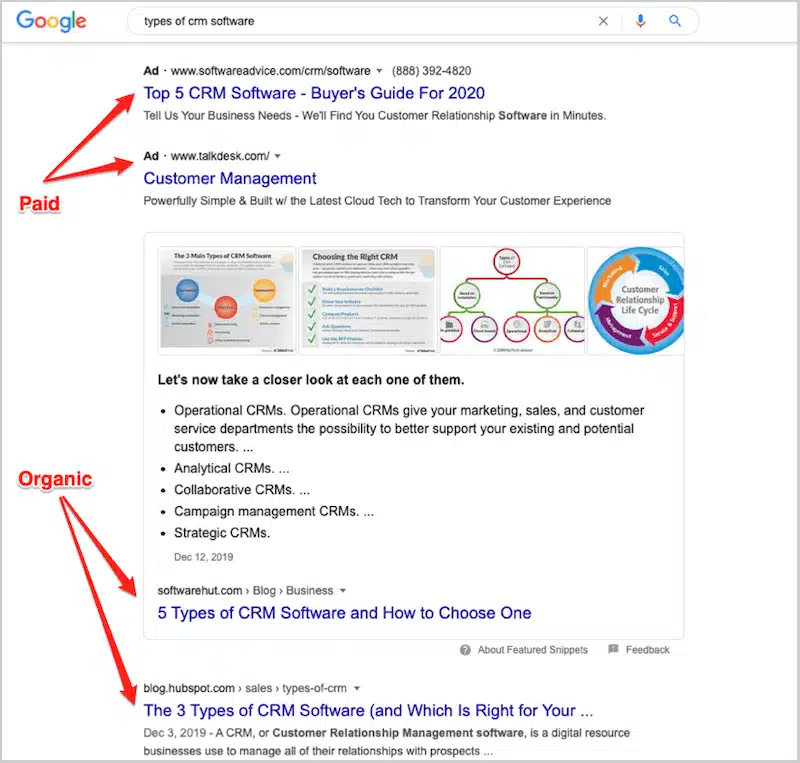
Sponsored results still hold the first positions on most commercial searches, marked "Sponsored". Since 2025, Search and Performance Max campaigns can also appear inside AI Overviews and AI Mode results, so paid search now reaches into the AI layer too. For product searches, Shopping ads with images and prices often take the whole first screen on a phone.
Paid placement is decided by an auction that weighs your bid against your Quality Score. A relevant ad with a matching landing page can sit above a competitor bidding twice as much. That is how a brand-new Adelaide concreting client of ours generated 61 leads in its first 20 days from about $800 of spend. It is also why we usually recommend running ads and SEO together: the ads cover the top of the page while organic rankings build.
If your searches are commercial and the first screen is all ads, Google Search Ads are the fastest way onto it. If you sell products, Google Shopping and Performance Max put your products, prices and photos into the Shopping results and the AI shopping panels.
DMT’s Take
Paid and organic are not rivals. The search-term data from your ads shows which organic terms actually convert, and strong organic rankings lift your brand searches and Quality Scores, which makes the ads cheaper.
Your Action Plan
- Count the ads above the fold for your top searches. If there are four, organic position one may still be below the first screen on a phone.
- Read our guide to what Google Ads costs in Australia before setting a test budget.
The local pack
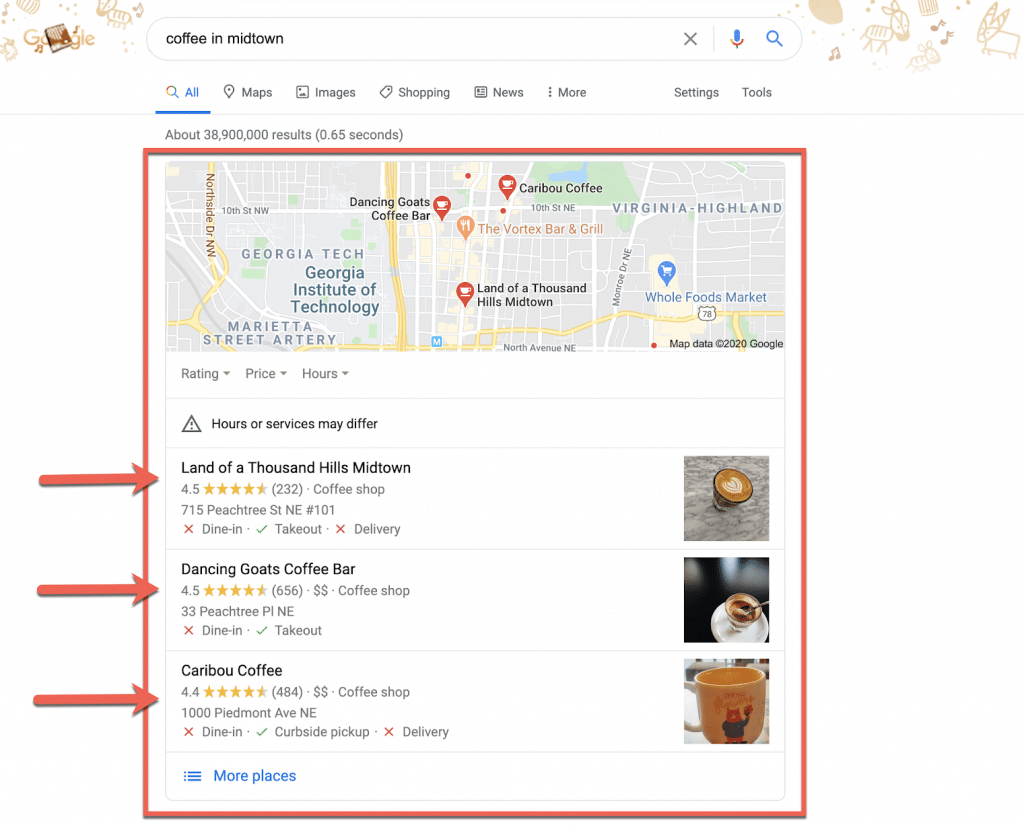
For any search with local intent, Google shows a map with three businesses, drawn from Google Business Profiles. For trades, clinics, hospitality and professional services, this is the most valuable spot on the page. It carries the call button, directions, reviews and opening hours, so many people never scroll past it.
Google ranks the local pack on relevance, distance and prominence. You cannot move your address, so the work goes into your Business Profile's primary category, a steady flow of reviews, consistent details across directories and real location pages on your site. Our FAQ on how to rank for local searches on Google lays out the six steps, and the DMT guide to local SEO goes deeper.
Your Action Plan
- Search your main service plus your suburb from a phone in that suburb. If you are not in the three, start with your Google Business Profile category and reviews.
Every other SERP feature worth knowing
- Featured snippets: a quoted answer from one page, shown above the organic results. They appear less often now that AI Overviews answer many questions, but they still show for plenty of how-to and definition searches. A clear 40 to 60 word answer directly under a question heading is the format that wins them.
- People Also Ask: expandable related questions. Each answer links to a page, and each one you open loads more questions. FAQ sections that answer the real follow-up questions earn these.
- Discussions and forums: threads from Reddit, Quora and niche forums, shown for searches where people want first-hand experience. Pew found Wikipedia, YouTube and Reddit together made up 15% of the sources cited in AI summaries.
- Videos: YouTube results with key moments, common for how-to and product searches.
- Images: image packs for visual searches, fed by descriptive file names, alt text and the text around the image.
- Shopping and popular products: product grids drawn from Merchant Center feeds and product schema. This is the core of e-commerce SEO.
- Knowledge panel: the box about a business or entity, fed by your Google Business Profile and consistent information across the web.
- Sitelinks: extra links under a brand result, generated from a clear site structure and internal links.
DMT’s Take
Pick two or three features that appear for your most valuable searches and build for those. Chasing every feature at once spreads the effort too thin.
What the new SERP means for clicks
More answers on the page means fewer clicks. In a study of real browsing behaviour, Pew Research Center found that users who saw an AI summary clicked a traditional search result in 8% of visits, against 15% for users who did not see one. They clicked a link inside the AI summary itself in just 1% of visits. They were also more likely to end their browsing session on that page.
We see the same pattern in our own Search Console data. Between June and September 2026, our Google Ads Canberra page ranked between positions 5 and 9 for ten commercial Canberra searches. It collected 10,739 impressions and 6 clicks. Page one, but below the ads and the map, and almost nobody scrolled that far.
Two things follow. First, impressions are now a visibility metric in their own right. Being seen in the AI answer or the map shapes who gets called, even without a click. Second, the clicks that do arrive are better qualified, so the page they land on has to convert. Our FAQ on the metrics worth tracking covers what to measure.
Want to know where you actually appear? We will check your top searches on today's results page, including AI Overviews and ChatGPT, and show you the biggest gaps. Free, no obligation.
How to win on today's SERP
- Map each important search to the spot you can hold. Ads for the commercial terms you need now, the map pack for local terms, organic and AI citations for questions, and Shopping for products.
- Make pages quotable. Put the answer first: plain facts, prices, steps and named people, written by someone who has done the work. Our copywriting team writes to this standard, and the method is in our post on using ChatGPT for SEO content.
- Add structured data. Organization, LocalBusiness, Service, Product, FAQ and Article schema help Google and AI systems understand what each page is.
- Keep the technical basics clean. Pages must be indexed, fast on phones and free of duplicate versions. See making your site mobile-friendly for SEO.
- Refresh what matters. Update prices, statistics and examples on your key pages at least once a year. Both Google and AI assistants favour current information.
- Build your presence off the site. Reviews, directory listings, industry mentions and genuine forum answers all feed the knowledge panel, the map pack and AI recommendations.
- Track it. Watch impressions and clicks in Search Console, AI referrals in GA4, and the live results page each quarter.
If you want to show up in ChatGPT's answers specifically, see our ChatGPT SEO service. If your rankings dropped suddenly, read how to recover from a Google penalty before changing anything. And for more short answers on search, browse our FAQ library.
DMT’s Take
The results page will keep changing. The businesses that keep winning are the ones that are easy to find, easy to verify and easy to quote, wherever on the page the answer appears.
Your Action Plan
- Pick your ten most valuable searches and write down which SERP spot you will target for each.
- Rewrite the opening paragraph of your top three pages so the answer comes first.
- Book a quarterly check of the live results page and your Search Console impressions.
Bilal Alwan
Bilal Alwan is the founder and director of Digital Marketing Tribe, an Adelaide and Sydney based digital marketing agency. He leads DMT’s SEO and AI search work, helping Australian businesses stay visible as search shifts from ten blue links to AI-generated answers.
Ready to Get Real Results?
Your free, no-obligation strategy session shows you exactly where the biggest opportunities are for your business.