
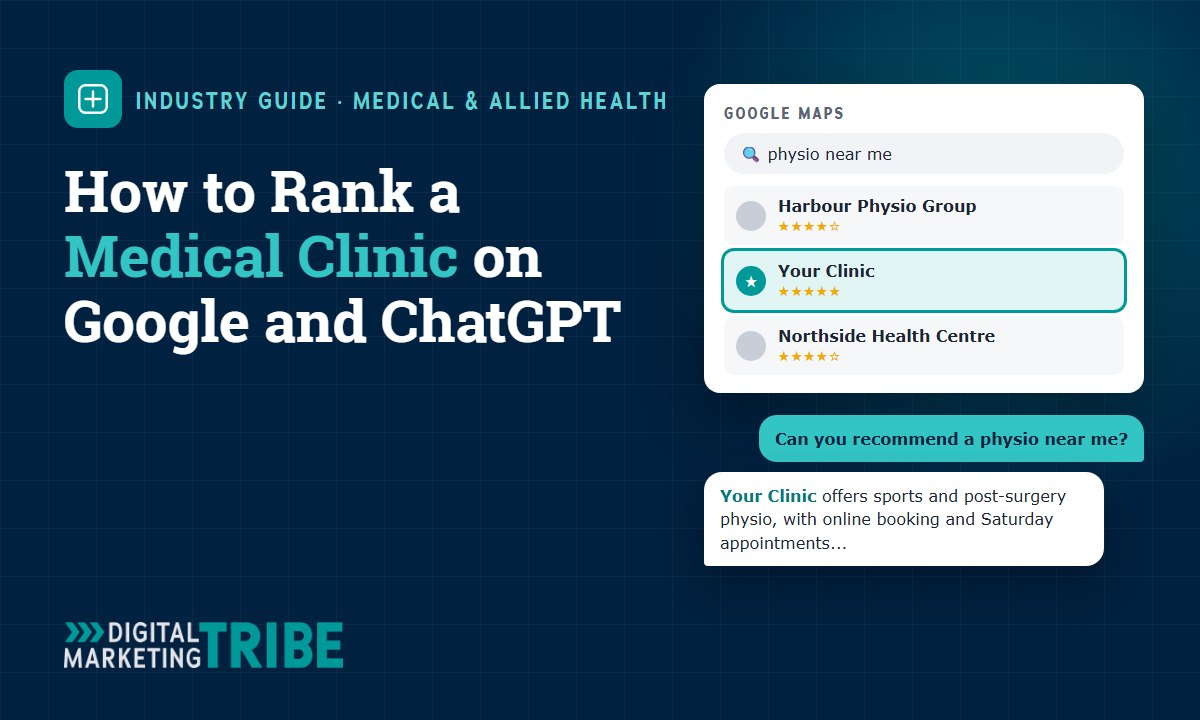
Patients choose a GP, physio or psychologist the same way they choose everything else: they search, compare and book. More of them now ask ChatGPT or Gemini for a recommendation first. Healthcare marketing in 2026 has to win both searches while following AHPRA's advertising rules, which are stricter than in any other industry. This guide covers how to do it, drawing on clinics we have built and ranked.
What does healthcare marketing need to rank on Google and ChatGPT?
Match how patients search. Build pages for every practitioner, service and suburb, each with a booking link.
AHPRA bans clinical testimonials. That includes your website, ads and social media pages.
Keep asking for reviews. Patients can still review you on Google, and reviews remain a strong local signal.
Consistency helps AI. Identical details across health directories make your clinic easier for ChatGPT to recommend.
Build the site around how patients search
Patients search for a clinic in three ways:
- By practitioner name, usually after a referral or a recommendation
- By service and location, such as "skin check Stirling" or "mental health care plan Mount Barker"
- By suburb, such as "doctor Hahndorf"
A site with a single services list cannot match those searches. When we built the website for Stirling Central Health Clinic, a GP and multidisciplinary centre in the Adelaide Hills with more than 20 practitioners, we built it around all three:
- A profile page for every practitioner, with photo, interests, availability and a direct booking link
- A page for every service group, from women's and children's health to chronic disease management, mental health, travel medicine and vaccination clinics
- Four suburb pages for the towns the clinic draws patients from: Bridgewater, Crafers, Hahndorf and Mount Barker
HotDoc booking sits on every page, so a search turns into an appointment without a phone call. See the Stirling Central case study.
Add MedicalClinic schema with your address, hours and practitioners so Google and AI tools can read the clinic's details directly.
AHPRA advertising guidelines: what clinics need to know
Every registered health practitioner who advertises must comply with the National Law. That covers GPs, dentists, physios, psychologists, chiropractors and other regulated professions. The rule that catches most clinics is the ban on testimonials.
According to AHPRA's testimonial guidance:
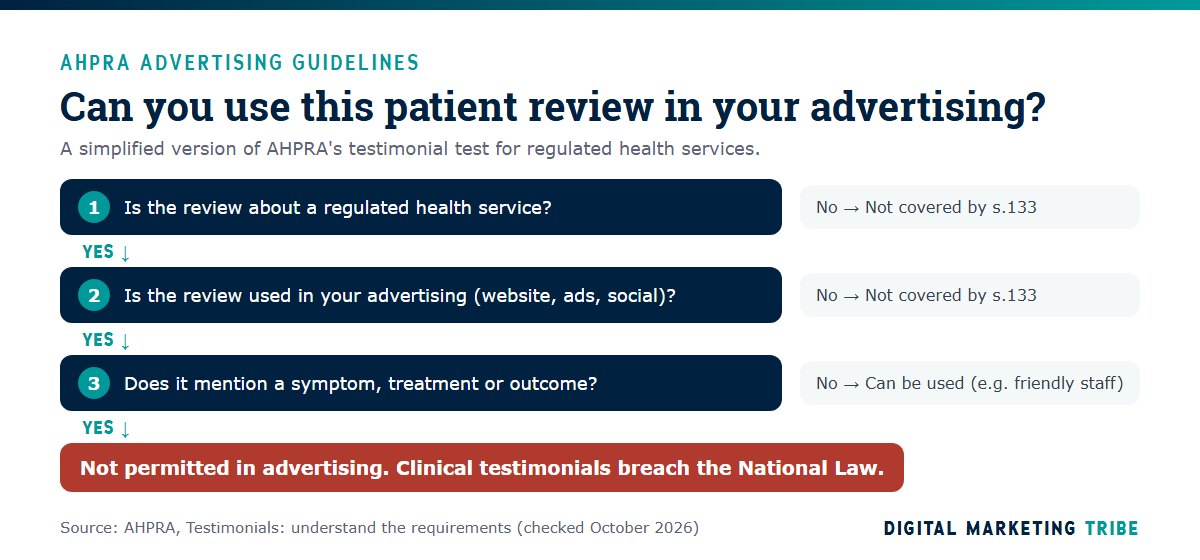
- A testimonial is a positive statement about a clinical aspect of a service: the symptom, the diagnosis or treatment, or the outcome
- Comments about customer service or communication style are not testimonials and can be used
- Patients can still post reviews on Google and other review platforms. The ban applies when the clinic uses those reviews to advertise
- A clinic's Facebook page counts as advertising. If patients post clinical reviews there, the clinic is responsible, and AHPRA suggests disabling reviews if needed
- Selectively publishing or editing reviews may break the law
In practice, this means no "my back pain is gone" quotes on your website, in ads or on social media. It also means checking any review widget you add to your site. AHPRA's advertising hub has the full guidelines and a self-check tool.
Reviews still matter: ask every patient
AHPRA's rules limit how you use reviews in advertising. They do not stop you asking for them, and reviews remain one of the strongest local ranking signals Google lists.
THEVA Remedial shows how quickly reviews compound once bookings start. The clinic had no website and no search presence in early 2026. In its first 90 days with us, it took 220 appointments from more than 100 customers and grew from zero to more than 700 organic visits a month, ranking for 90 keywords. It now has 85 Google reviews at a 5.0 average. Read THEVA's story.
Remedial massage is not one of the professions regulated under the National Law, so THEVA faces fewer advertising limits than a GP or physio. The review process still applies to every clinic: send a short SMS with a direct review link after each appointment, ask everyone, and never offer an incentive.
How to get your clinic recommended by ChatGPT
When a patient asks "who is a good physio in Glenelg?", AI assistants build the answer from websites, directories and reviews. To give them something to work with:
- Allow AI crawlers. Check that robots.txt does not block OpenAI's OAI-SearchBot or Google's crawlers.
- Keep details identical across Google, Bing Places, HealthEngine, HotDoc, Healthdirect and your own site.
- Answer patient questions in plain language. "Do I need a referral to see a physio?" and "What does a mental health care plan cover?" are the questions people ask AI. Factual, non-promotional answers are what gets quoted.
- Show who the practitioners are. Real names, qualifications and AHPRA registration build the trust that both Google and AI tools look for in health content.
Test it monthly. Ask ChatGPT, Gemini and Perplexity the questions your patients ask and record whether your clinic appears.
Healthcare marketing checklist
- Practitioner, service and suburb pages, each with a booking link
- MedicalClinic schema on the site
- No clinical testimonials in any advertising, including social media
- Review widgets checked against AHPRA's testimonial tool
- Review request sent after every appointment
- Clinic details identical across health directories
- Monthly AI visibility check
Healthcare marketing FAQs
Can a clinic show Google reviews on its website?
Only with care. Under AHPRA's guidance, a review that mentions a symptom, treatment or outcome is a testimonial and cannot be used in advertising, and your website counts as advertising. Reviews about service, such as friendly staff or easy parking, can be used. If you add a review widget, make sure it cannot display clinical comments.
Do physios, psychologists and chiropractors follow the same rules as GPs?
Yes. Physiotherapy, psychology, chiropractic, osteopathy, podiatry, optometry and the other professions regulated under the National Law all follow the same advertising rules. Unregulated services, such as remedial massage, fall outside them but must still meet Australian Consumer Law.
Conclusion
Healthcare marketing works when it matches how patients search and stays inside AHPRA's rules. Build pages for every practitioner, service and suburb, keep reviews coming in, and keep clinical testimonials out of your advertising. The same work that ranks a clinic on Google makes it easier for ChatGPT to recommend.
Want a compliant plan for your clinic? Our SEO for doctors and healthcare providers team can audit your site, Google profile and AI visibility. Start with a free Website AI Audit or explore our local SEO services.
Want a compliant plan for your clinic? We will audit your website, Google profile and AI visibility, with AHPRA’s advertising rules in mind.

Bilal Alwan
Bilal Alwan is the founder and director of Digital Marketing Tribe, an Adelaide and Sydney based digital marketing agency. He leads DMT’s SEO and AI search work, helping Australian businesses stay visible as search shifts from ten blue links to AI-generated answers.
Get Your Clinic Found by More Patients
Your free audit shows how your clinic performs on Google Maps, on your website and in AI answers, and what to fix first.