
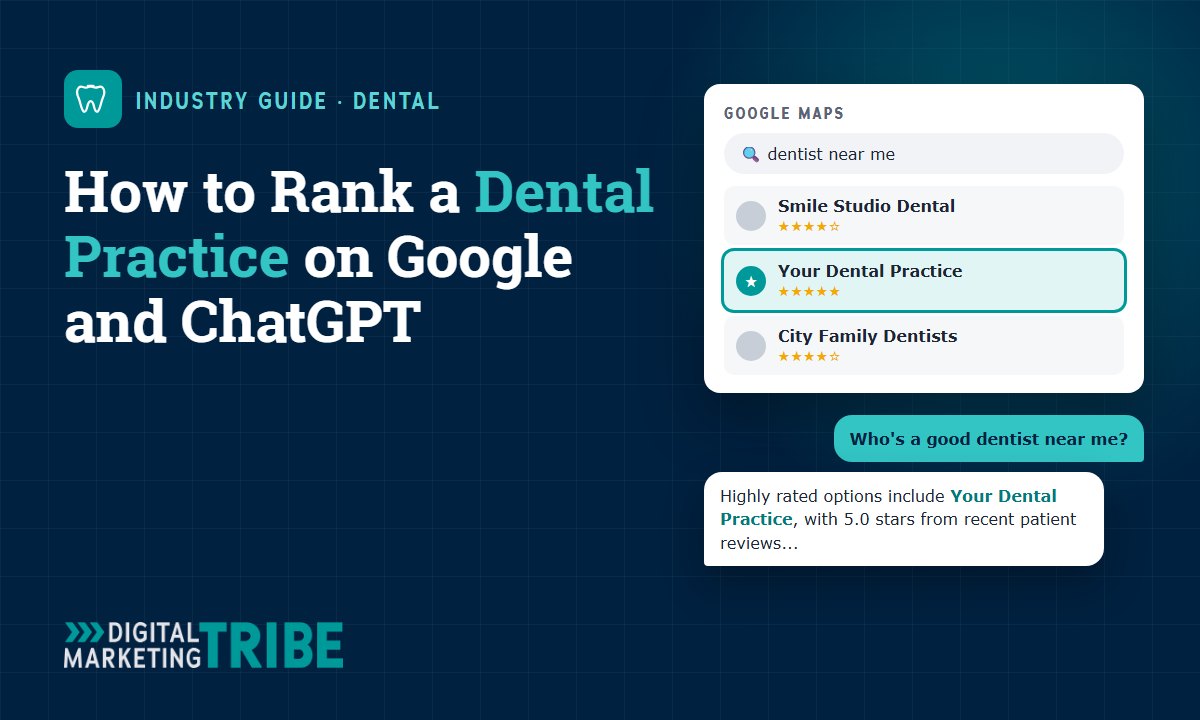
Patients now find a dentist two ways: they search Google Maps, or they ask an AI assistant such as ChatGPT or Gemini to recommend one. Local SEO for dentists has to cover both. This guide explains how to rank a dental practice in each, using what we have learned from dental and orthodontic clients, and how to do it without breaching AHPRA's advertising rules.
How do you rank a dental practice on Google and ChatGPT?
Two places to win. Google’s map pack and AI answers both draw on your profile, reviews and website.
One page per treatment. Implants, Invisalign and emergency care each need their own page to rank.
AHPRA limits testimonials. Patients can review you on Google, but clinical reviews cannot be reused in your advertising.
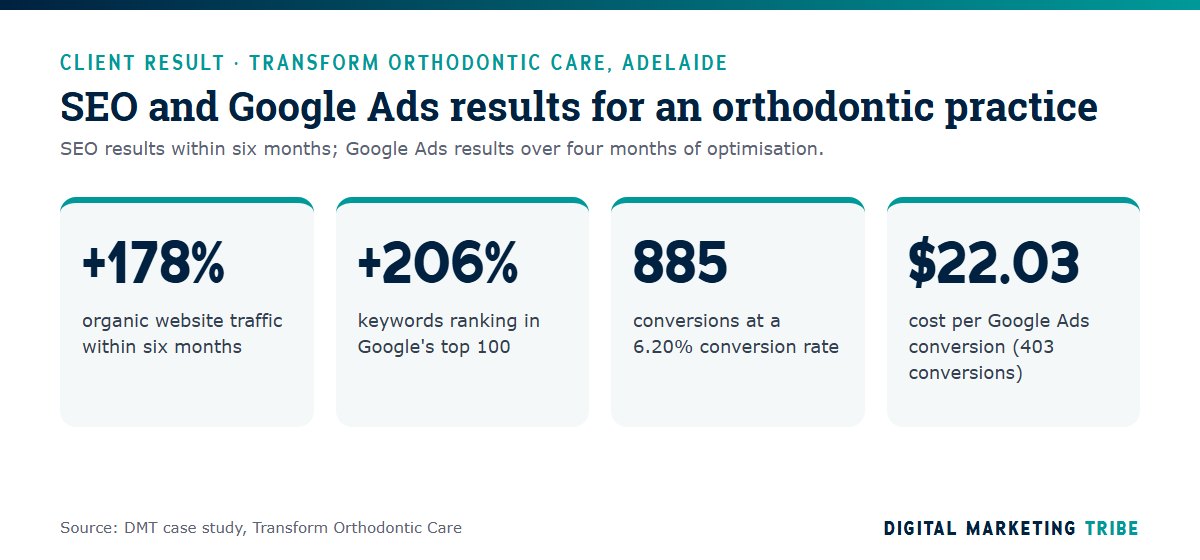
Ads fill the gap. TOC’s campaigns delivered 403 conversions at $22.03 each while SEO built up.
The rest of this guide breaks each step down.
Step 1: Win the Google map pack first
Most "dentist near me" searches show a map pack of three practices above the organic results. That pack drives the calls.
Google says local ranking comes down to relevance, distance and prominence. You cannot change distance. You can control the other two:
- Primary category: set it to "Dentist" or your specialty, such as "Orthodontist". Add secondary categories only for services you actually offer.
- Services list: add every treatment, from check-ups to implants and clear aligners, with a short description.
- Photos: real photos of the team, rooms and front of the practice. Stock photos add nothing.
- Hours and booking link: keep them current, including public holidays. Link straight to your online booking page.
- Reviews: more on these below, because they carry special rules for dentists.
Step 2: Build one page per treatment
A single "Our Services" page cannot rank for implants, veneers, Invisalign and emergency dental at once. Each treatment needs its own page that answers what a patient types in: what it is, who it suits, what it costs (or a price range), how long it takes and how to book.
We used this structure for Transform Orthodontic Care (TOC) in Adelaide. Within six months, TOC's organic traffic grew 178% and the number of keywords ranking in Google's top 100 grew 206%. The site produced 885 conversions at a 6.20% conversion rate. Read the TOC case study.
Add schema markup to each page so search engines and AI tools know exactly what the business is. Schema.org has a dedicated Dentist type for this.
Step 3: Get more reviews, but know the AHPRA testimonial rule
Reviews influence both the map pack and AI recommendations. Dentists face a rule most businesses do not.
Under the National Law, a registered health practice cannot use testimonials about clinical aspects in its advertising. According to AHPRA's testimonial guidance, a clinical aspect is any mention of a symptom, a diagnosis or treatment, or an outcome. Comments about customer service or communication style are not testimonials.
What this means in practice:
- Patients can post reviews on Google. AHPRA says the prohibition does not affect patients posting reviews on review platforms.
- You cannot reuse clinical reviews in your advertising. That includes quoting "my implant looks perfect" on your website, in a social post or in an ad.
- Be careful with review widgets. A website widget that pulls in review text can display clinical comments on your own site. Check it against AHPRA's tool before you install it.
- Never selectively edit reviews. AHPRA warns this may break the law.
Ask every patient for a review after their appointment, by SMS with a direct link. Do not offer incentives, and do not ask only the patients you expect to be happy.
Step 4: Make your practice easy for ChatGPT to find and trust
AI assistants answer "best dentist in [suburb]" questions by pulling from websites, directories and review platforms. Three steps make a practice easier to recommend:
- Let AI crawlers in. OpenAI's documentation says sites that block its OAI-SearchBot crawler will not be shown in ChatGPT search answers. Check your robots.txt.
- Keep details identical everywhere. Use the same practice name, address and phone number on Google, Bing Places, HealthEngine, HotDoc and your own site. Mismatches make it harder for AI tools to confirm you are one business.
- Answer real questions in plain text. "How much does a filling cost?" and "Do you bulk bill for children?" are the questions patients ask AI. Put clear, factual answers on your treatment pages and FAQ.
Google's own guidance says there are no special requirements to appear in AI Overviews beyond strong SEO fundamentals. The work in steps 1 to 3 does double duty.
To check your progress, ask ChatGPT, Gemini and Perplexity the questions your patients ask, such as "best dentist in Norwood", once a month. Record whether your practice appears. That is your AI visibility baseline.
Step 5: Use Google Ads while SEO builds
SEO takes months. Google Ads can fill the appointment book while it does. For TOC, four months of optimised campaigns produced 403 conversions at $22.03 each, from 3,061 clicks at an average of $2.90 per click.
Ads work best for high-value treatments such as implants, Invisalign and emergency appointments. Track every booking and call as a conversion, or you will not know which keywords pay. Our guide to Google Ads costs has more real figures.
Local SEO for dentists: a quick checklist
- Google Business Profile complete, with the correct primary category
- One page per treatment, with prices or price ranges
- Dentist schema on the site
- Review requests sent after every appointment, with no incentives
- No clinical testimonials in any advertising
- Practice details identical across Google, Bing and health directories
- OAI-SearchBot allowed in robots.txt
- Monthly AI visibility check in ChatGPT, Gemini and Perplexity
Conclusion
Local SEO for dentists now means ranking in two places: Google's map pack and AI answers. The same foundations win both: a complete profile, genuine reviews, a page for every treatment and consistent details. Add AHPRA compliance and you have a practice that patients and AI tools can trust.
Want to see where your practice stands? Our SEO for dentists team runs a free audit covering Google Maps, your website and your AI visibility. See also our local SEO services and ChatGPT SEO.
Want more patients from Google and ChatGPT? We will audit your Google profile, website and AI visibility and show you what to fix first.
Bilal Alwan
Bilal Alwan is the founder and director of Digital Marketing Tribe, an Adelaide and Sydney based digital marketing agency. He leads DMT’s SEO and AI search work, helping Australian businesses stay visible as search shifts from ten blue links to AI-generated answers.
Get Your Practice Found on Google and ChatGPT
Your free audit shows where your practice stands in the map pack, on your website and in AI answers, and what to fix first.