
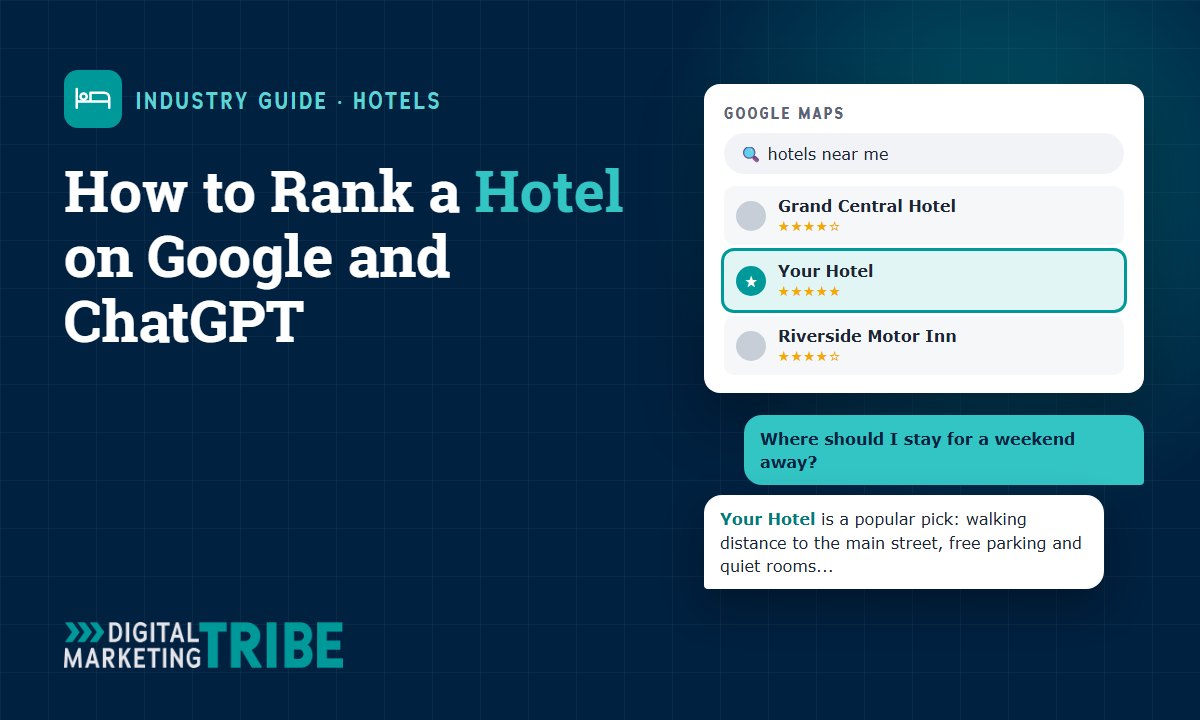
Every booking that comes through an online travel agency costs a hotel a commission. Every booking that comes through your own website does not. Hotel marketing in 2026 is about winning more of those direct bookings, from Google search, from Google's hotel results and, increasingly, from travellers who ask ChatGPT where to stay. This guide shows how, using results from a hotel we work with.
What is the most effective hotel marketing strategy?
Direct bookings carry no commission. Every booking moved off an OTA is margin back in your pocket.
Treat your Google profile like a booking page. Strong photos, every amenity and a direct booking link.
Build pages around why people visit. Events, business travel, weddings and seasonal stays.
It works. Tom’s Court lifted direct revenue from $10k to $22k a month in six months.
Why direct bookings matter: the Tom's Court Hotel result
When Tom's Court Hotel partnered with us in February 2025, most bookings came through third-party platforms such as Booking.com and Stayz. The hotel's own website brought in around $10,000 a month from about 2,500 monthly visitors.
We combined SEO and Google Ads to push travellers to book direct. In just over six months:
- Direct website revenue grew from $10,000 to $22,000 a month, a 120% increase
- Website visitors grew from 2,500 to 4,400 a month, up 76%
- Ranking keywords grew from 395 to 974
- Top-3 Google rankings grew from 13 keywords to 35
Read the full Tom's Court Hotel case study.
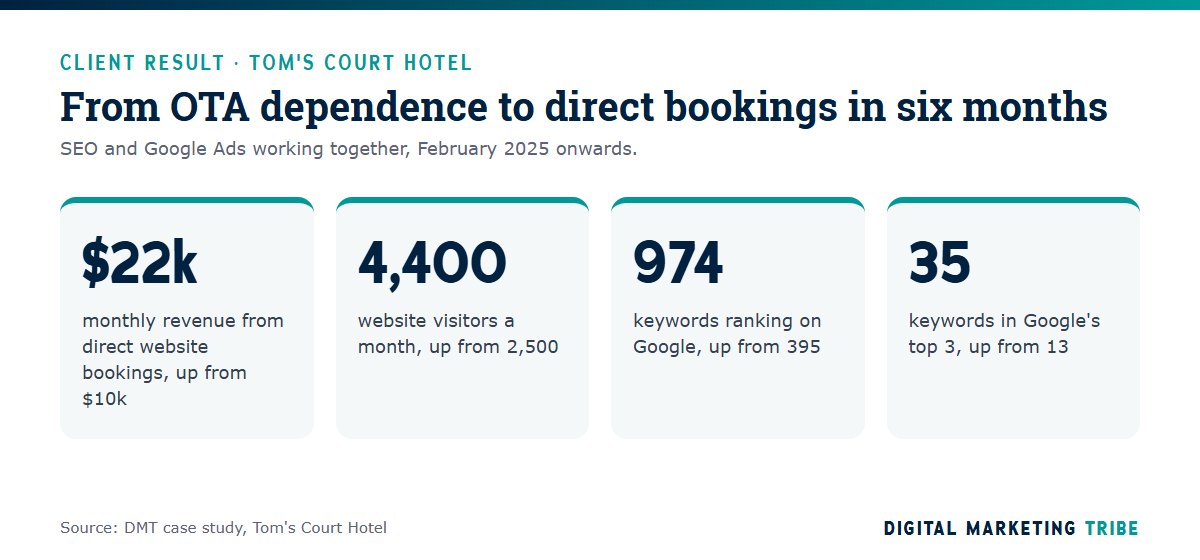
That extra revenue carries no OTA commission. That is the business case for hotel marketing.
Step 1: Make your Google Business Profile work like a booking page
For a hotel, the Google Business Profile is often the first thing a traveller sees. Treat it like a sales page:
- Upload strong photos of every room type, the view, the bar or restaurant and the entrance at night
- Fill in every amenity Google offers, such as parking, pool, pet-friendly or accessible rooms
- Reply to every review, especially the negative ones. Travellers read the replies
- Add your direct booking link so travellers do not have to go through an OTA
Google's hotel search results can also show prices from your own booking engine next to OTA prices, through Google Hotel Center. If your booking engine supports it, connect it. It puts your direct rate in front of travellers at the moment they compare.
Step 2: Build pages around why people visit
Travellers rarely search for your hotel's name first. They search for the reason they are travelling: "hotel near the convention centre", "pet friendly accommodation Barossa", "wedding accommodation [venue name]".
Create a page for each real reason guests come:
- Nearby events, venues and attractions
- Business travel, with distances to key offices or the airport
- Weddings, functions and group bookings
- Seasonal stays, such as festivals and school holidays
This is the content strategy that grew Tom's Court's ranking keywords by more than 500 in six months. Mark up your site with Hotel schema so search engines and AI tools can read room types, amenities and location.
Step 3: Use Google Ads to win high-intent searches
Someone searching "[your town] accommodation this weekend" is ready to book. Google Ads puts your direct rate in front of them before the OTAs.
For Tom's Court, our ads team researched competitor and OTA activity, then refined campaigns to convert visitors into direct bookings rather than clicks. Three rules make hotel ads pay:
- Track bookings and revenue, not just clicks, so you know the real return
- Bid on your own hotel name, or OTAs will take those clicks and charge you commission for guests who were already looking for you
- Send traffic to the booking-ready page, not the homepage
Step 4: Get your hotel recommended by ChatGPT
Travellers now ask AI assistants "where should I stay in Hobart for a weekend?" To give AI tools a reason to name your hotel:
- Keep details consistent across Google, Bing Places, TripAdvisor and the OTAs
- Collect reviews on more than one platform. AI answers often summarise what guests say across several sites
- Write clear, specific content about what makes the stay worth it: walking distance to the main street, free parking, quiet rooms, late check-in
- Allow AI crawlers. OpenAI states that sites blocking its OAI-SearchBot crawler will not be shown in ChatGPT search answers
Hotel marketing FAQs
Should hotels stop listing on Booking.com and other OTAs?
No. OTAs bring in guests who would never find you otherwise, especially first-time and international visitors. The goal is balance: use OTAs for reach, and win repeat guests and people already searching your area through your own website. Grow direct bookings first, then decide how much OTA inventory you still need.
How do I encourage guests to book direct?
Give them a reason. Offer something only available direct, such as free breakfast, late checkout, flexible cancellation or a best-rate guarantee. Show the offer on your website and Google Business Profile, and make sure your booking engine works in a few taps on a phone.
What should a hotel marketing budget cover first?
Start with the foundations that touch every booking: a complete Google Business Profile, a fast website with a working booking engine, and Google Ads on your own hotel name. Add content and wider ad campaigns once you can track which bookings each one brings in.
Conclusion
Good hotel marketing shifts bookings from commission-heavy OTAs back to your own website. A strong Google profile, pages built around why guests visit, focused Google Ads and consistent details across the web will help you rank on Google and get recommended by ChatGPT. For Tom's Court, that meant direct revenue more than doubling in six months.
Want more direct bookings? Our SEO for hotels team combines SEO, Google Ads and ChatGPT SEO in one plan.
Want more direct bookings? We will combine SEO, Google Ads and AI search into one plan to move bookings off the OTAs.

Bilal Alwan
Bilal Alwan is the founder and director of Digital Marketing Tribe, an Adelaide and Sydney based digital marketing agency. He leads DMT’s SEO and AI search work, helping Australian businesses stay visible as search shifts from ten blue links to AI-generated answers.
Win More Direct Bookings
Your free strategy call shows where your hotel stands on Google and in AI answers, and how to shift more bookings direct.