
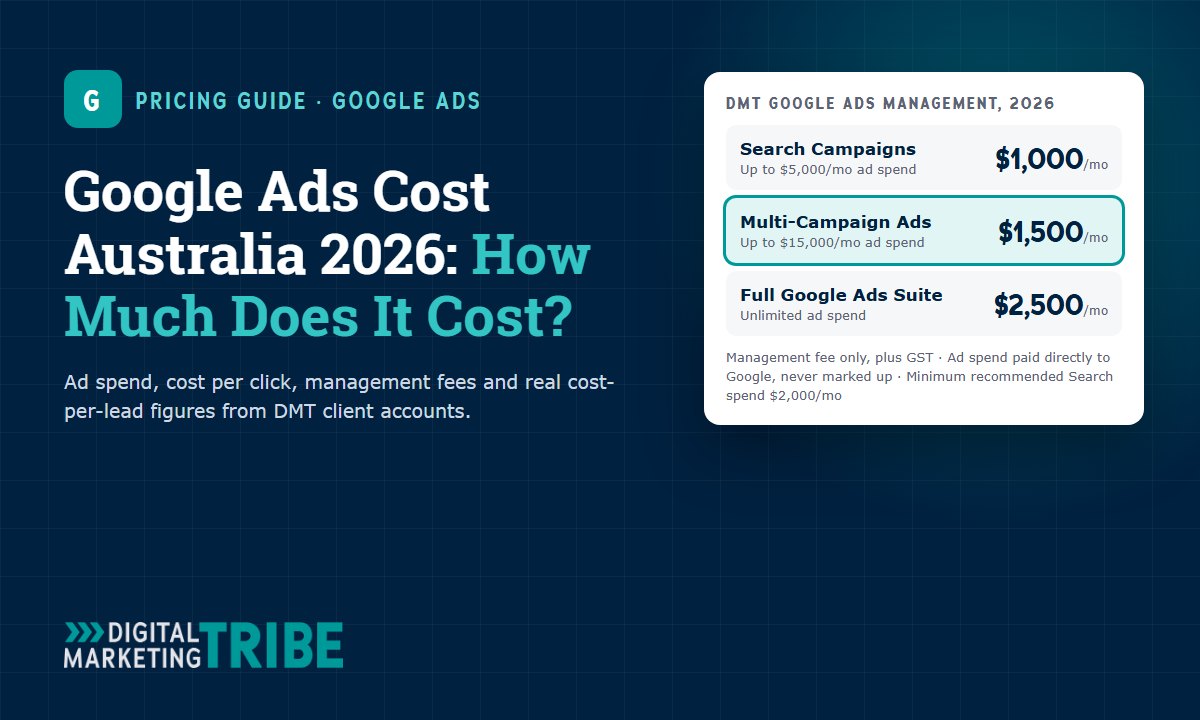
Google Ads cost has two parts: ad spend paid to Google and a management fee. Most Australian small businesses spend $2,000 to $5,000 a month on clicks and $500 to $5,000 a month on management.
DMT's management fees are $1,000, $1,500 and $2,500 a month plus GST, with ad spend paid straight to Google and never marked up. Minimum recommended Search budget is $2,000 a month.
Real accounts beat averages. DMT clients have paid $0.52 a click and $35.60 a sale (Mistral), $22.03 a lead (Transform Orthodontic Care) and $2.60 a conversion on Performance Max (KPark).
Quality Score, not bid size, is the biggest lever on cost per click, and AI-driven bidding now does the maths faster than any human. The job of management is to feed it the right data.
TL;DR: what Google Ads costs in Australia in 2026
Every month about 590 Australians search "google ads cost", 480 search "google ads pricing" and 260 ask "how much do google ads cost" (Semrush, October 2026), and the honest answer is that it depends on what you sell, who you compete with and how well the account is run. This guide works through each part of the bill, shows what DMT's own client accounts actually pay, explains how AI is changing the auction, and tells you what to ask before you sign a management agreement.
How the Google Ads auction sets your cost per click
Google Ads is pay-per-click: you bid on the searches you want to appear for and pay only when someone clicks. Every time a search happens, Google runs an instant auction among the advertisers bidding on that query. Your position and your price are decided by Ad Rank, which is your bid multiplied by your Quality Score, with ad extensions and context added in. Google explains the mechanics in its own help centre under About Quality Score.
The practical result is that you rarely pay your maximum bid. You pay just enough to beat the advertiser below you, adjusted for quality. An ad with a Quality Score of 8 can sit above a competitor bidding twice as much, and pay less for the click. Four things move your cost per click:
- Keyword competition. The more advertisers want a search, the higher the clearing price. "Emergency plumber sydney" costs more than "plumber hunters hill".
- Quality Score. Expected click-through rate, ad relevance and landing page experience. Higher scores buy the same position for less.
- Location. Sydney and Melbourne CBD clicks cost more than regional ones for the same term, because more businesses are bidding.
- Device and audience. Mobile, desktop and remarketing audiences each clear at different prices.
DMT’s Take
Outspending a competitor does not guarantee the top spot. The accounts that pay the least per click are the ones with tight ad groups, ads that match the search word for word, and landing pages that answer the query. That is account hygiene, and it is the cheapest cost lever you have.
What Google Ads costs per click and per lead: real accounts
Industry averages hide a lot, so here are figures from DMT's published case studies, taken from the clients' own Google Ads accounts.
Mistral Appliances, national e-commerce. Over 18 months from January 2025, Google Ads delivered 899 online sales from $31,992 of spend: $35.60 a sale. The campaigns returned 61,500 clicks at an average $0.52 a click across 3.7 million impressions. Once we consolidated the tracking and moved budget to the campaigns that sold, return on ad spend rose from 5.1x to 7.9x and monthly website revenue grew from $12,256 to $22,562 on the same $2,000 monthly budget.
Transform Orthodontic Care, Adelaide specialist practice. 403 conversions at $22.03 each over four months of optimisation, from 97,719 impressions and 3,061 clicks at $2.90 a click.
KPark, Adelaide car parks. More than 800 bookings across Search and Performance Max, with Performance Max converting at $2.60 and Search click-through rates above 7% on 866,000 impressions.
AJ Concreting, brand-new Adelaide trade business. 61 leads from about $800 of spend in the first 20 days, roughly $13 a lead, and $140,000 of quoted jobs before the first month was out.
Tom's Court Hotel, Adelaide. With Google Ads and SEO running together, monthly website revenue grew from $10,000 to $22,000 in just over six months, with direct bookings replacing commission-heavy third-party platforms.
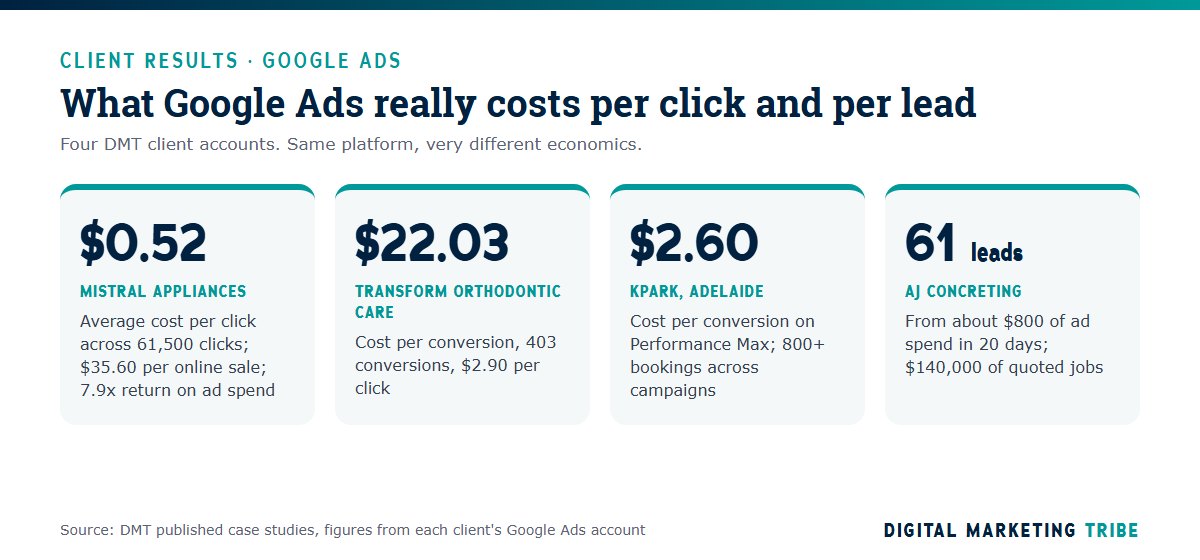
Same platform, very different economics. A $0.52 click that sells a $442 appliance and a $20 click that books a $5,000 orthodontic case can both be excellent. The only cost figure that matters is yours, measured against what a customer is worth to you.
Your Action Plan
- Benchmark your cost per click against your own industry and city, not a national average.
- Work backwards from customer value. If a new client is worth $3,000 and you close one in four leads, you can afford $300 a lead and still make money.
Google Ads management fees in Australia
Running an account well is continuous work: keyword research, campaign structure, ad copy and testing, conversion tracking, search-term reviews, bid strategy, negative keywords and reporting. Agencies charge for it four ways.
Flat monthly retainer ($500 to $5,000 a month). A fixed fee for an agreed scope. Predictable, and it does not reward the agency for spending more of your money. This is how we price.
Percentage of ad spend (10% to 20%). Common at larger agencies. Scales with the account, but the agency earns more when you spend more, whether or not the extra spend converts.
Hourly ($100 to $250 an hour). Suits one-off audits and training. Expensive for ongoing management because optimisation is many small tasks.
Performance (per lead). You pay per enquiry. The incentive is volume, not quality, and the lead definition is usually the agency's. We do not offer it.
A one-off account setup (structure, conversion tracking, launch) is typically $800 to $3,000, and an audit of an existing account $500 to $1,500. Google's own representatives (1800 418 664 in Australia) will help you set up for free, but they work for Google, and their advice is the same advice your competitors get.
DMT’s Take
A management fee buys judgement, not button-clicking. Ask what the agency did in the account last month and what it changed as a result. If the answer is "the campaigns are running", you are paying for monitoring, not management.
DMT's Google Ads management pricing in 2026
Our fees are flat, published and separate from your ad spend, which you pay directly to Google from your own account. We never mark up your budget. Every tier includes conversion tracking, Responsive Search Ad copywriting, negative keyword management and a monthly performance report. Prices are per month plus GST, month to month.
| Package | Management fee | Ad spend it covers | What's included |
|---|---|---|---|
| Search Campaigns (Starter) | $1,000/month | Up to $5,000/month | One campaign with up to three ad groups, keyword research and match types, Responsive Search Ad copywriting, conversion tracking setup, monthly performance report |
| Multi-Campaign Ads (Growth) | $1,500/month | Up to $15,000/month | Search and Display campaigns, remarketing audiences, A/B ad copy testing, negative keyword management, smart bid strategy optimisation, monthly strategy call |
| Full Google Ads Suite (Performance) | $2,500/month | Unlimited | Search, Display, Shopping and YouTube, full-funnel strategy, landing page recommendations, dedicated strategist, priority support, fortnightly performance review |
| Google Ads Setup | from $1,500 one-off | Any | New account build, campaign structure, conversion tracking, launch |
| Google Ads Audit | from $800 one-off | Any | Campaign structure, wasted spend, Quality Score, tracking and compliance review with a prioritised fix list |
| SEO + Google Ads bundle | from $3,200/month | Per the Ads tier | One team, one report, search-term data feeding the organic strategy |
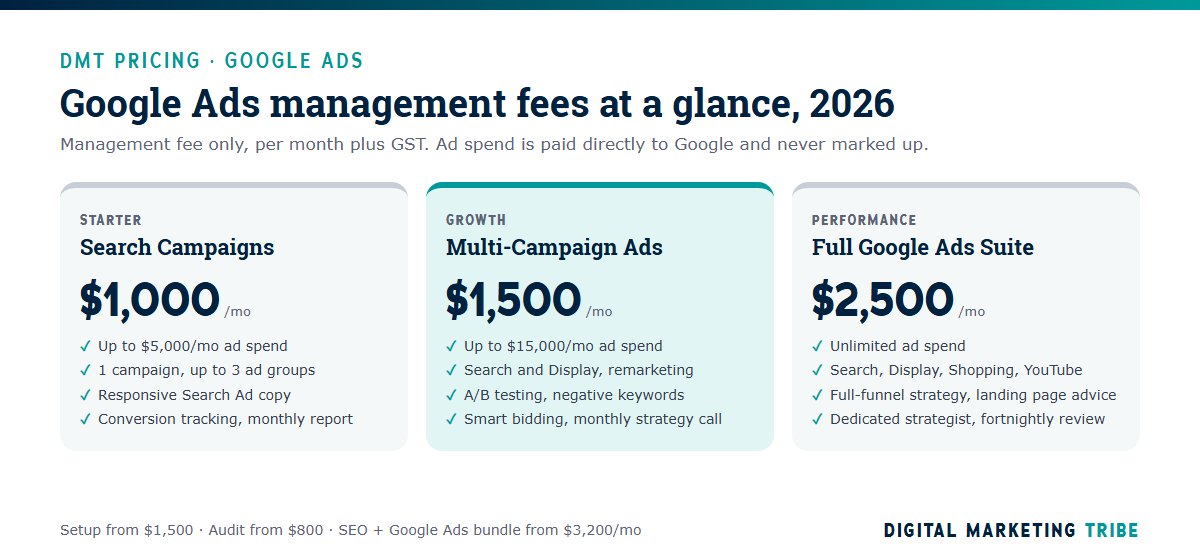
So a local service business on the Starter tier spending $3,000 a month on clicks pays $4,000 a month in total; an e-commerce store on the Growth tier spending $10,000 pays $11,500. Not-for-profits can combine our management with Google Ad Grants, which provides up to US$10,000 a month of free Search spend to eligible charities. City pages give the same pricing with local context: Google Ads Canberra, Google Ads Melbourne and our Google Ads service page.
How much should you spend on Google Ads?
Enough to buy statistically useful data. At $4 a click and a 5% conversion rate, $2,000 buys 500 clicks and about 25 leads a month, which is enough to see which keywords and ads work. At $500 a month you get 125 clicks and six leads, and you will spend six months guessing. That is why our minimum recommended Search budget is $2,000 a month.
Typical Australian budgets by business type:
- Local trades and services: $2,000 to $5,000 a month. AJ Concreting started at under $1,500 a month and filled its pipeline, but concreting leads in Adelaide are cheap; a Sydney emergency plumber would need three times that.
- Professional services (legal, medical, finance): $3,000 to $10,000 a month, because clicks cost $10 to $30 and a single client is worth thousands.
- E-commerce: $5,000 to $30,000 a month depending on catalogue size and margin, with Shopping and Performance Max carrying most of it.
- Hospitality and tourism: $1,000 to $5,000 a month, seasonal, and often brand-heavy to pull bookings away from Booking.com and the other third-party platforms.
Budgets should also move. Trades lift spend when they hire; retailers lift it before Christmas and the end of financial year; seasonal businesses such as pool builders and heating brands follow the weather. Mistral's strongest month came from pointing the same $2,000 at the right campaigns, not from spending more.
Your Action Plan
- Set a 90-day test budget of at least $2,000 a month and judge it on cost per lead, not clicks.
- Budget for the full cost: ad spend, management, and any call tracking or landing page tools, which a good agency includes rather than bills separately.
How AI is changing Google Ads costs
Google Ads in 2026 is run by machine learning whether you like it or not. Smart Bidding sets the bid for every auction from signals no human can see, Performance Max decides which channel to show your ad on, and AI Max for Search campaigns expands your keywords to searches you never typed in. Google's AI Overviews and AI Mode have also pushed organic results further down the page, so the paid slots at the top carry more of the clicks than they did two years ago.
That changes what you pay for. The machine is better than any manager at bidding, but it is only as good as the data it learns from. If your conversion tracking counts a thank-you page view, a phone click and a form fill as three conversions, Smart Bidding will cheerfully buy more of the cheapest one. Mistral's account had $4,110 of spend and seven abandoned checkouts tracked as "conversions" before we took it over; fixing the measurement was what unlocked the 7.9x return.
AI also cuts the labour on the management side, and we pass that on. We run an AI assistant over every client's search terms report each week to flag irrelevant queries as candidate negatives, then a specialist approves the list before it goes into the account. On one dental account that routine caught 40 wasted search themes in a month that a quarterly manual review would have missed. The saving shows up in your cost per lead, which is why our Starter tier is $1,000 a month and not $1,500.
DMT’s Take
Automation does not make management optional. It moves the job from pulling levers to feeding the algorithm clean conversion data, tight negatives and landing pages that convert. Those are exactly the things a cheap, set-and-forget account never gets.
How to reduce Google Ads costs
Five levers, in the order we pull them on a new account.
- Fix the tracking first. One clean conversion action per real outcome. Everything else is noise that the bidding algorithm will optimise toward.
- Improve Quality Score. Match ad copy to the search, send each ad group to a landing page about that service, and watch cost per click fall for the same position.
- Add negatives every week. Mistral's Shopping campaign was showing fans and heaters to people researching $2,000 Thermomix and Ninja machines; the negatives alone saved a meaningful share of the budget.
- Tighten geography and schedule. Show ads only where you serve and when you can answer the phone. A missed call is the most expensive click in the account.
- Use long-tail and intent-rich keywords. "Driveway concreter adelaide hills" costs less and converts more than "concrete".
Google Ads vs SEO: which should you pay for first?
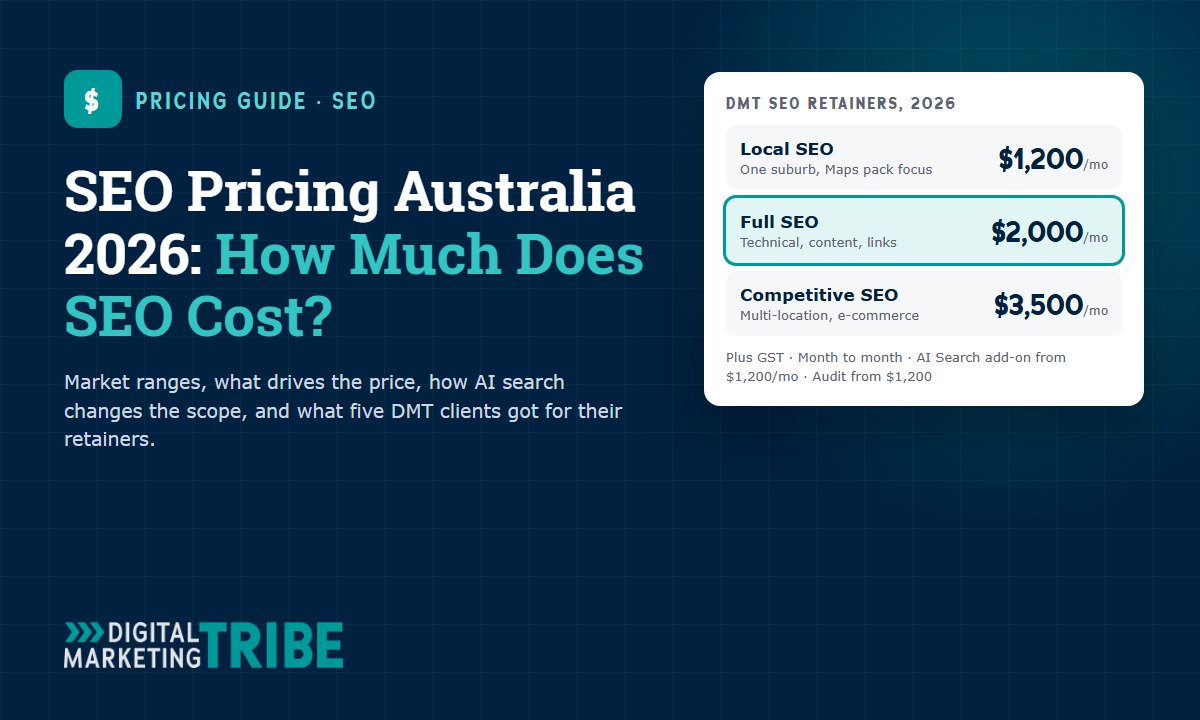
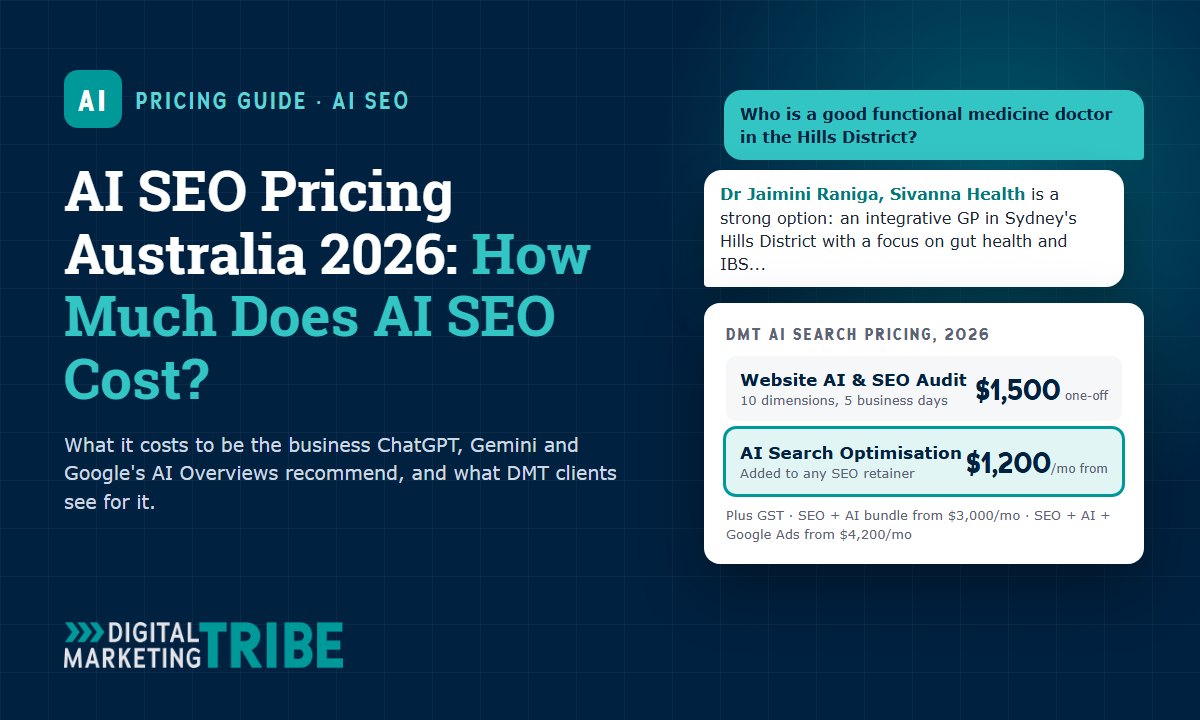
Google Ads produces enquiries in the first week and stops the day the budget stops. SEO takes three to six months to move and keeps producing after the work is done. The best accounts we run do both: the paid search-term data tells the SEO team which organic terms convert, and the organic rankings lower the paid cost by lifting brand searches and Quality Score. Tom's Court Hotel's $10,000 to $22,000 revenue growth came from the two running together. If budget forces a choice, a business with no organic presence should start with Ads for cash flow, then move budget into SEO as rankings arrive. Our SEO pricing guide covers the organic side, and AI SEO pricing the new AI search layer.
What to look for in a Google Ads proposal
- Ad spend separate from the fee, paid from your own Google Ads account, which you own and keep if you leave.
- A named scope: campaign types, number of campaigns and ad groups, how often search terms are reviewed, what gets tested.
- Conversion tracking in the first fortnight, with a definition of what counts as a lead.
- Reporting on cost per lead and revenue, not impressions and clicks.
- Google Partner status and a specialist you can name, not a shared inbox.
- Month to month terms. There is no technical reason for a twelve-month Google Ads contract.
- Red flags: a fee that is a percentage of spend with no cap, guaranteed positions, "proprietary bidding technology", and an agency that wants the account in its own name.
Want to know what Google Ads would cost for your business? Book a free account audit. We will show you your likely cost per click, a realistic budget and the management tier that fits, whether or not you hire us.
Google Ads cost FAQs
How much does Google Ads cost per month in Australia?
Most small and medium businesses spend $2,000 to $5,000 a month on ad spend plus $500 to $5,000 a month on management, so $2,500 to $10,000 all in. E-commerce and professional services spend more. DMT's management fees are $1,000, $1,500 and $2,500 a month plus GST, with ad spend paid directly to Google.
What is the average cost per click in Australia?
About $3 to $5 across most industries. Shopping clicks for everyday products can be under $1 (Mistral averaged $0.52), local services sit at $3 to $8, and legal, insurance and finance terms run $20 or more. Your Quality Score and location shift the figure substantially.
How much does a Google Ads agency charge?
Flat retainers of $500 to $5,000 a month, or 10% to 20% of ad spend. DMT charges flat fees of $1,000 (up to $5,000 of spend), $1,500 (up to $15,000) and $2,500 (unlimited) a month. Setup is from $1,500 and an audit from $800.
What is the minimum budget for Google Ads?
Technically a few dollars a day. Practically, $2,000 a month for Search is the least that produces enough clicks and conversions to optimise against within a quarter. Below that you are paying for data you will never collect.
Is Google Ads worth it for a small business?
Yes, when the maths works: cost per lead below what you can afford given your close rate and customer value. AJ Concreting turned about $800 into 61 leads and $140,000 of quoted work in 20 days. A business with a long sales cycle and a $200 product will find it harder.
Do I pay the agency for my ad spend?
Not with us. Ad spend goes from your card or bank account to Google, in your own account. Our fee is separate, so we have no incentive to spend more of your money than the results justify.

Bilal Alwan
Bilal Alwan is the founder and director of Digital Marketing Tribe, an Adelaide and Sydney based digital marketing agency. He leads DMT’s SEO and AI search work, helping Australian businesses stay visible as search shifts from ten blue links to AI-generated answers.
Ready to Get Real Results From Google Ads?
Your free, no-obligation account audit shows where your budget is going, what a lead should cost and the management tier that fits.